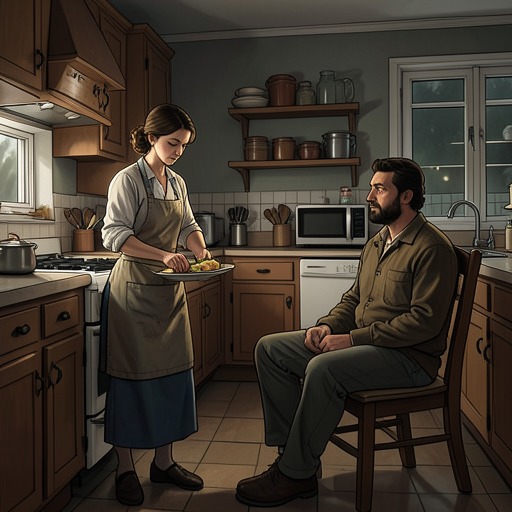
Catherine
The Shrinking ManCatherine is a teenager who visits the Carey household and becomes the focus of Scott Carey’s increasingly intrusive attention. The text offers little access to her private thoughts; instead, it shows her through Scott’s fantasies, his watching, and the moment she catches him outside the house. That narrow perspective makes her presence consequential not because she seeks conflict, but because it reveals how Scott’s shrinking isolation is entangled with his own choices and loss of restraint.
Identity and Presence
Catherine arrives at the house while Louise Carey is there, and her voice is first heard alongside Beth Carey’s. Scott identifies it as the voice of an adolescent girl, but his initial attempt to imagine Catherine’s appearance is explicitly shaped by his fancy. The detailed image he constructs is therefore evidence of his projection, not a reliable account of her actual appearance or character. The distinction matters: the narrative initially gives readers Scott’s desire before it gives them a grounded sense of the girl he is imagining.
Later, Scott revises his estimate of her. He thinks she may be fourteen or fifteen, while Louise says she thinks Catherine is sixteen. Neither statement supplies a definitive age, but both establish that Catherine is a teenager. The uncertainty also sharpens the troubling imbalance in the scene: Scott is an adult, while the person attracting his attention is a girl whose age he himself has to wonder about.
A Presence Filtered Through Scott
Catherine’s ordinary activities appear in the narrative largely because Scott watches and interprets them. He hears her speaking with Beth and tries to picture her; later, through a window, he sees her reading a magazine. When she and Beth play catch, Scott watches from atop boxes, then realizes that he has been waiting for Catherine to bend to retrieve the ball. His recognition unsettles him enough that he clumsily gets down and returns to his chair.
The passage follows not Catherine’s intentions but Scott’s response: tense observation, abrupt self-consciousness, anger, and a shaken attempt to calm himself with water. The narrative thus separates the girl’s limited, visible actions from the elaborate significance Scott assigns to them. Catherine is not shown encouraging his attention or knowing its extent at this point. The distinction prevents his fixation from being mistaken for a relationship between them.
Routine and Surveillance
Scott’s interest becomes a repeated routine rather than a passing distraction. He brings a small clock to the cellar, giving Louise the explanation that he wants to keep track of time; privately, he uses it to work out when Beth is napping. He then leaves through the window to peer into the house. The clock, which appears to be a practical object, becomes a tool in a schedule organized around watching Catherine.
His observations depend on chance. Some days he sees her occupied with commonplace tasks; at other times he catches glimpses that he treats as a success. As September wanes and the weather grows colder, Catherine and Beth spend more time indoors, making Scott’s opportunities to watch from outside less frequent. He returns to the cellar angry and sulks through the afternoon, then snaps at Louise. At night he waits impatiently for morning, and his dreams of Catherine become more alluring to him. This cycle shows the reach of his fixation: it shapes his time, his mood, and his treatment of Louise, although Catherine remains unaware of most of it.
Discovery
The surveillance ends when Scott is outside the kitchen and loses his footing on the porch boards. Catherine calls out after hearing the noise. He jumps down and runs around the house; from the kitchen window, she sees him fleeing in his childlike form and stares at him, frozen with surprise. Her response is the first clear indication that she has discovered his presence outside.
Scott spends the afternoon hiding behind the water tank. Although Catherine has not seen him go into the cellar, he fears that she is looking through its window and imagines the consequences of Louise learning what he has done. The scene turns his private routine into an exposed act: Catherine’s startled look is enough to make him retreat, while his own fear shifts toward the prospect of being recognized and judged. The passage establishes her as the witness to his behavior, without giving her a motive beyond reacting to what she sees.
Narrative Role and Limits
Catherine has little independent characterization in these scenes. The narrative supplies no account of her family relationship to Beth, her reasons for visiting, or her understanding of Scott beyond the moment at the window. Her speech is brief, and her actions—talking, reading, and playing catch—remain ordinary. The relative scarcity of information about her is part of the scene’s design: Scott’s attention fills the space where her perspective might otherwise be, and that imbalance reveals more about him than about her.
Her discovery nevertheless changes the meaning of the preceding routine. What Scott had maintained as a private, timed practice is now visible to its subject, and his frantic flight contrasts with the controlled schedule he had built around watching. Catherine’s role is therefore both limited and decisive: she is not an active antagonist, but her presence exposes the boundary Scott has crossed and brings his self-deception into contact with another person’s gaze.